
Is this student's identity an obstacle?
Or is it her superpower? -- with mad nods to America Ferrera

If you haven’t seen America Ferrera’s TED talk from 2019, please watch it now.
I saw a clip this week and had to watch the rest of it. So articulate and uncompromising about her identity: she was always aware of the stereotyping by the people who had the power to hire her. Yet their problem — their bias — didn’t stop her.
Here’s her Instagram “identity”:
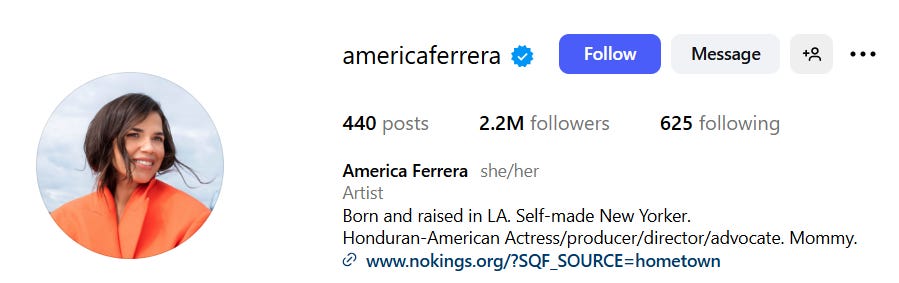
This is a person who shows confidence in their own identity! I’m filled with admiration, and that’s a large group of us: 2.2 million!
I kept wondering as I watched her TED talk, did her elementary school teachers affirm the asset of her identity? Or, had they seen her identity as an obstacle, a deficit she must overcome or compensate for?
What about her 7th grade teacher? Her high school social studies teacher? Her PE teacher? What if she’d been in my 11th grade English class? Would I have highlighted her identity or kept her in the shadows? How would the texts we read in class — a fairly unquestioned American literature anthology and a couple plays and novels —affirmed her and helped her become confident in herself?
A few years ago, several of my former students — African American students — were recalling on social media when they had been treated with racism at school. Many of those incidents were typical “micro-aggressions” and then there were some that were more hostile, bordering on violent. I didn’t hear of any that included physical violence. Reading their memories was a shock to me, and some of my fellow teachers also responded with shocked regret and sorrow. Almost all of those incidents had been their fellow students doing and saying things they shouldn’t have, and not their teachers or coaches, but they still occurred. We teachers just hadn’t been aware.
Here’s an interesting quote from Ileana Najarro:
“Through surveys of more than 3,400 students in the mid-Atlantic region so far, she [Sophia Rodriguez, an associate professor of educational leadership and policy studies at New York University] found that Latino youth report lower levels of belonging than their white peers. These students said teachers did not explicitly address microaggressions and racial harassment either through schoolwide dialogues or disciplinary consequences for those who made Latino and immigrant students feel unwelcome.”I imagine my former students would also report “lower levels of belonging.” I imagine that their feeling “unwelcome” would have a significant impact on their academic success, not to mention their self-confidence. Despite the fact that our school’s ideals included that every member was an important part of the school family. Despite the fact that me and my colleagues — those students’ teachers — were unaware. Were we not physically in those spaces where these incidents occurred? Were we there but didn’t notice? Did we notice but not think it was a big deal? Did we figure someone else would handle the issue?
I conclude that regardless of why I wasn’t aware in the past, there must be ways to bring the conversation about identity out into the open. Until we can do that together, how can we proceed away from the current divisiveness in our civic discourse?
My desire to take steps away from the destructive power imbalance in our society is one of the reasons I was so eager for Facing History and Ourselves’ “Teaching for Equity and Justice” workshops this summer. Part 1 happened in June, and part 2 just wrapped up last week. These workshops have been instrumental in my developing awareness of how things are for most students in American schools. And awareness of some effective ways to make changes for those kids.
Considering identity as a deserving, even a necessary, topic to investigate now seems obvious. There are several templates available, and Facing History even has some videos and lesson plans demonstrating how to make identity consideration a key part of class. Opening up this topic, especially important at the beginning of the school year, could certainly set a tone of openness, maybe even acceptance. Could it even spark mutual appreciation and lead to true community?
If our nation is ever to be civil together again, won’t it have to start with listening to one another as we are?
What do you think?
It’s always rewarding to see that someone took the time to respond. A conversation is such a good start, don’t you think? Is there someone with whom you’d like to have a conversation about this? Please share with them!